
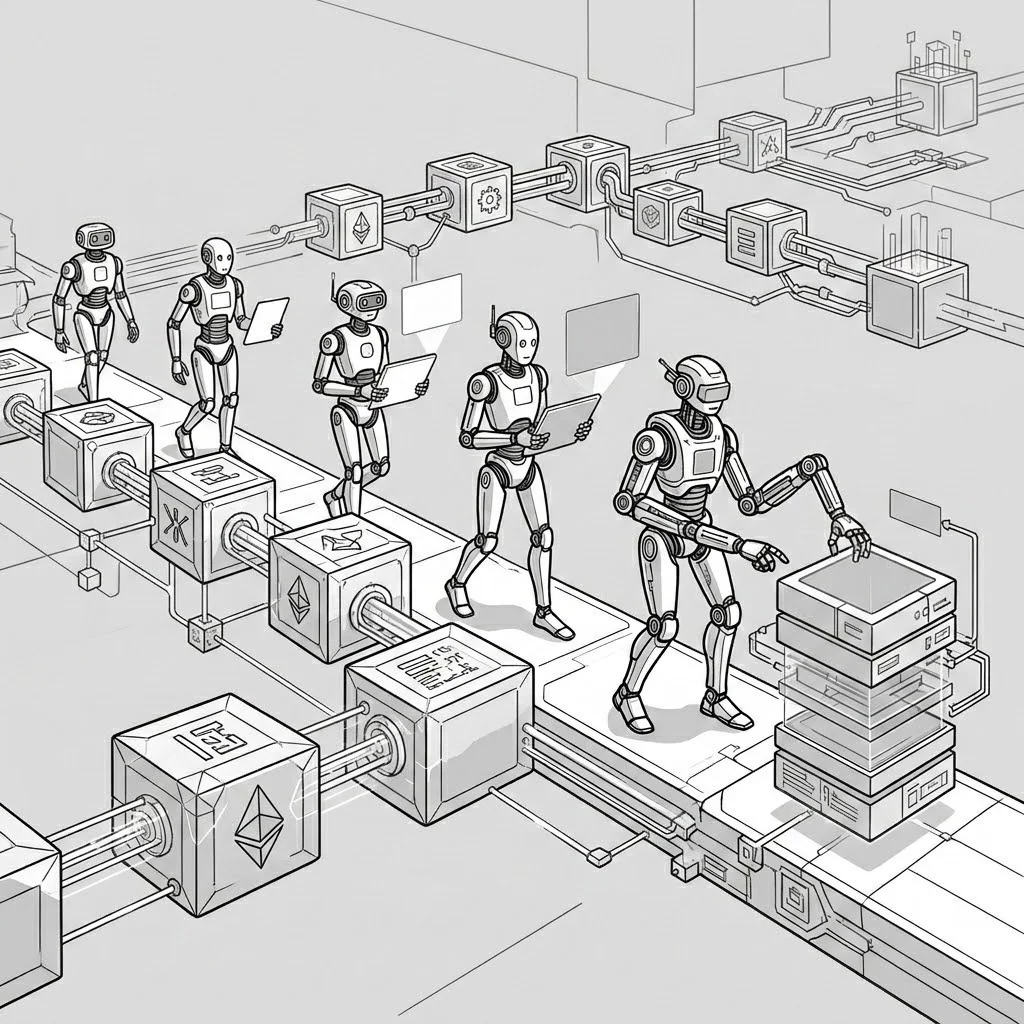
The infrastructure that Web3 spent a decade building was never particularly well-suited to the way humans actually transact. The UX made that obvious. Wallets were confusing. Gas fees were unpredictable. Seed phrases were a single mistake away from permanent loss. Smart contracts assumed counterparties who could read code. Every interaction demanded a level of technical fluency that most people simply do not have, and the industry spent years trying to paper over that gap with better interfaces.
It is worth asking why the underlying infrastructure felt so hostile to human users in the first place. The answer is that it was not really designed around human behavior. It was designed around properties: speed, programmability, permissionlessness, finality. Those properties are not what humans need from a payment system. They are exactly what machines need.
The Problem AI Agents Have That Web3 Already Solves
AI agents need to transact. Not metaphorically. Literally. An autonomous agent orchestrating a workflow needs to pay for compute, settle API calls, compensate contributors, distribute rewards, and move value across systems, all without a human approving each step.
Traditional financial infrastructure cannot support this. Bank accounts require identity verification tied to a legal person. Payment processors require contracts, compliance reviews, and human oversight. Every settlement involves latency, intermediaries, and friction that a machine operating at millisecond speed cannot absorb.
Web3 infrastructure was designed without those constraints. Wallets have no legal prerequisites. Smart contracts execute automatically when conditions are met. Transactions settle in seconds, not days. Programmable money means value can be moved according to logic, not paperwork.
For the first time, an AI agent can hold capital, make payments, and settle obligations without a human in the loop at the point of execution.
What This Actually Looks Like
The use cases are not theoretical. They are already emerging.
AI agents are being deployed to manage treasury operations, execute grant disbursements, pay service providers on milestone completion, and coordinate cross-chain liquidity. In each case, the agent is not assisting a human decision. It is making and executing the decision autonomously, using Web3 rails as its financial infrastructure.
The technical fit is precise. Multisig wallets allow approval thresholds to be encoded directly into the governance of an agent’s spending. Smart contracts replace the need for bilateral legal agreements. Onchain activity creates an auditable record of every transaction without requiring a third party to maintain it. Stablecoins remove the volatility that would otherwise make automated treasury management operationally unworkable.
The infrastructure was built for decentralization. What is arriving is automation. The two are more compatible than most anticipated.
The Part No One Has Figured Out Yet
The technical compatibility is real. The governance and compliance frameworks are not ready.
When an AI agent transacts, the fundamental questions of accountability become genuinely difficult. Who owns the wallet the agent controls? Who is the legal counterparty when a smart contract executes autonomously? If an agent moves funds in a way that triggers AML screening, who is the responsible person? If a transaction is fraudulent or exploited, what recourse exists and against whom?
Traditional compliance frameworks were designed around legal persons, whether individuals or corporations, who could be identified, verified, and held accountable. An AI agent fits none of those categories cleanly. It can hold a wallet address but not a passport. It can sign a transaction but not a contract. It can move capital across jurisdictions in milliseconds in a way that no human compliance process was designed to monitor.
Foundations deploying AI agents without governance frameworks around those agents are accumulating risk they cannot easily quantify. The agent’s behavior is a liability if it is not properly scoped, monitored, and accountable to a defined human or legal entity.
Security Is the Other Conversation
The attack surface expands significantly when agents transact autonomously. A compromised agent is not just a technical problem. It is a financial one. An agent with access to a treasury wallet that gets manipulated through a prompt injection, a poisoned data source, or a misconfigured permission set can move capital before any human notices.
The security model for AI agent transactions requires the same discipline that applies to any treasury operation: separation of access, spending limits, time-locks, multi-party approval thresholds for large transactions, and onchain monitoring that flags anomalous behavior in real time. Most organizations deploying agents today are operating without these controls in place.
The assumption that agent transactions are low-stakes because they are small is already outdated. Agents compounding micro-transactions at scale can move material amounts of capital. The risk is not in the individual transaction. It is in the aggregate, and in the absence of governance around the agent’s mandate.
A Different Kind of Maturity Test
Web3 has spent years arguing about whether its infrastructure was ready for institutions. The more immediate question is whether it is ready for agents.
The rails are ready. The programmability is ready. The settlement speed is ready. What is not ready is the governance layer that sits above it: the compliance frameworks, the accountability structures, and the security discipline required to deploy autonomous financial actors responsibly.
Foundations already working through these questions are finding that the answers touch every layer of their operating structure, from treasury policy to entity governance to service provider contracts. The organizations that build that layer now will be positioned to operate at a scale that is not otherwise reachable. Those that treat agent deployment as a technical project rather than a governance one will discover the gap the hard way.
Web3 was not built for how humans transact. It was built for what comes next. The infrastructure is waiting. The question is whether the organizations using it are prepared for what operating at machine speed actually demands.

Business Development and Marketing at Mugen